Here's a couple of videos from the influential Ferox '85 group.
Founding members of the group were Ron Greer and Alistair "Aya" Thorne, both scientists at the Freshwater Fisheries Laboratory in Pitlochry, Perthshire. Their quest was the elusive Ferox Trout.
It was an episode of Hooked on Fishing by Paul Young,
http://youtu.be/Uh7tYjoofeQ
also once a member of the scientific team at Pitlochry which inspired my interest in the search for Scottish Ferox Trout, which is as Ron Greer describes in his book " Ferox trout and Arctic Charr "
can be, " a brain numbing, bum-numbing fishless eternity. Those who will survive will be relatively few and will thoroughly deserve their fish. "
How wonderful it is that the Ferox '85 group continues their quest into the 21st century !
Showing posts with label Ferox. Show all posts
Wednesday, 10 March 2010
Aquatic "wolf" that lives on from the Ice Age
Back in 2009, I was priveledged to be asked by Bruce Sandison if he could use a photograph of mine in his recently re-released and fully updated book Rivers and Lochs of Scotland.
I was delighted that Bruce asked this of me and gladly gave him proofs of the pictures of the trout we caught on a highland loch in August last year.
The book was subsequently sent to the publishers including a picture of our trout and further to this Bruce also asked that he could use the photograph in an article for the Inverness Courier on Friday 30th october 2009. Again I was delighted for the picture to be published and have finally got around to posting the article here with the kind permission of Bruce.
Unfortunately the article is in two sections at the moment but I hope to resolve this shortly. Due to the small text as a result of the article being scanned, I've done a transcript below.
I hope you enjoy Bruce's insight into fishing for ferox trout in the highlands of Scotland.


TRANSCRIPT
Ferox - The Aquatic Wolf From The Ice Age
One fine summer day a few years ago my wife Ann and I were fishing Loch Laidon for brown trout. This dramatic loch lies at the heart of Scotland where it silver-ribbons Rannoch Moor for five-and-half narrow miles. Off Eilean Iubhair, 'the island of the yew tree', the boat bobbed gently over the waves in an accommodating breeze. Small trout rose to my flies, Black Pennell, March Brown and Silver Butcher. My fishing partner and I were well content, at peace with the world and all that it contained.
A moment later we were becalmed. The wind fell and fish stopped rising. Not a dimple stippled the mirror-like surface. Resigned, but content just to be there, we reeled in and opened a flask of coffee. A suicidal bluebottle buzzed impotently on the water a few yards from the boat. As I watched it struggle for flight, from out of the depths, in slow motion, a huge trout appeared and leisurely head-and-tailed over the doomed insect.
I turned to my companion, pointing, lost for words. Ann had seen the fish. We gaped in synchronised amazement. The rise seemed to go on forever, first the great head, then a vast, broad dark back, dorsal fin and adipose fin and finally the upper section of a sail sized tail. The trout was in no hurry and gave us plenty of time to exmine it in intimate detail. When speech returned, we said, simultaneously, " did you see that " and estimeted the weight of the fish to have been in excess of 10lb.
Ferox trout have survived in Scottish lochs for more than 10,000 years. They are special because they have retained their genetic integrity. Until recently, little was known about their lifestyle and habits other than the fact that they appear to subsist virtually entirely upon Arctic charr; although, as voracious hunters, ferox seem quite happy to snap up other morsels that come their way, including the odd unfortunate bluebottle.
however, artic charr are the preferred diet and the number of ferox in any given loch depends upon the health of the locla charr population. The size of ferox is also governed by the size of the prey species. Ferox eat fish which are generally one third of their own length. Therefore, if the charr population consists of small fish, this will restrict the ultimate size of the ferox which feed upon them. The ideal scenario for ferox is to live in a loch with a large population of modest-sized fish, like Loch Laidon. In such circumstance, ferox grow rapidly and can attain weights of up to and over 20lb in the space of six years.
The reason more is known about ferox today is largely due the activities of the ferox '85 Group, formed by fishery scientists such as Andy Walker, Alistair Thorne, Ron Greer and others.
They have devoted much of their energy and time to the study of these great fish and over the years built up an invaluable data bank of information on Scottish ferox.
And they are following in illustrious footsteps. Charles St. John (1809-56) recalls. " I was crossing Loch Ness alone one evening with my rod at the stern of the boat, with my trolling tackle trailing behind. Suddenly a large trout sized it and before I could do anything but take hold of my rod he had run out eighty yards of line and bent my stiff trolling rod like a willow. "
In 1880, Sir John Colquhoun of Luss noted: "The largest feroxes taken in Scotland, not even excepting Loch Awe, have been taken out of Loch Rannoch.... At Loch Rannoch, in twenty-eight years, three of twenty-three, twenty-two and twenty pounds' weight have been taken."
Catching ferox is a lot harder than writing about catching them. Ron Greer describes the experience thus " No matter how good you become, or how often you try, you are never going to catch massive numbers of fish. In the process you will alternatively approach hypothermia, heat stroke exhaustion, desiccationand drowning. So if your pleasure comes from catvhing hoards of tame rrainbows ...my advice to you regarding ferox angling is - don't even start. My favourite summary is that it will feel like a brain numbing, bum-numbing fishless eternity. Those who will survive will be relatively few and will thoroughly deserve their fish. "
The best places to break both your heart and your tackle in pursuit of ferox are the same today as they were in the days of Osgood MacKenzie, Charles St John and Sir John Colquhoun. Happily, they are readily accessible and, mostly, boats are available for hire. In the Southern Highlands, consider a visit to lochs Lomond, Awe, Tay, Rannoch, Laidon, Garry and Laggan. Further north, try your luck on lochs Ness, Lochy, Arkaig, Garry, Quoich, Morar, Sionascaig, Loyal and Calder. Crossing the fingers will also help mightily.
All that now remains to be done is to construct that glass case for above the mantelpiece. When you do so, think big. Given dedication to duty, perseverance, sheer cussedness, determination and grit, you could, one day, fill it with the fish of your angling dreams, the Aquatic 'Wolf' from the Ice Age, Scotland's most noble freshwater fish. In pursuit of it you will be linked to the birth of all life forms in the land I love, fish, fowl and flora, animal and human.
Ferox Trout, by Ron Greer, published by Swan Hill Press, 1995 (ISBN: 1 85310 486 8)
About the Author: Bruce Sandison is a highly respected writer, journalist and author of various books, including the definitive anglers' guide, The Rivers and Lochs of Scotland. He has contributed to most angling magazines over the years and his work has also appeared in a wide range of UK newspapers and journals, and on BBC radio and television.
Tight lines to all for the new season.
Fishinscotland.
Labels:
Ferox
Tuesday, 18 August 2009
Ferox
Yesterday, we left Cumbernauld for the North West Highlands. Our quest, most definately Ferox Trout. I don't claim to be an expert on Ferox or how to catch them but must have learned a bit over the years. So, we went hunting for " the Aquatic wolf from the ice age " with the resolution to catch one of these beautiful specimens which are not, as is the common myth, " ugly trout ".
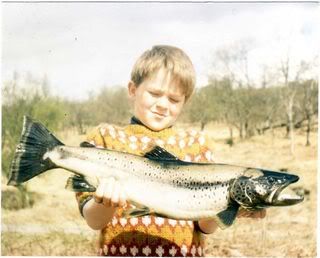
Over 30 years ago, my father caught one of these beauties on another loch in the North West highlands. The fish was around five pounds in weight and at that time we did not know it as a Ferox taking it only to be a large brown trout which must have changed to a fish diet at some point in it's life cycle.
All rights reserved
It was a lovely and well marked fish and regrettably we " chapped it on the head ". In those days this was the norm and the fish was kept for the table. These days, we'll still keep smaller trout but would encourage anyone catching large Ferox to return them. In some way, it's my view, trout which have lived long enough to reach maturity deserve the chance to live another few years and possibly pass their gene's onto the next generation of Ferox. I suppose this makes a case for not taking any trout for the table whatsoever and advocating 100% catch and release. My answer to this would be, 100% Catch and release is a relatively new concept, Ferox have been thriving for thousands of years.
Anyway, what do I know. Back to the trip and the fishing. We travelled up through Fort William to arrive at our camp site for 10 p.m. the light was just beginning to fade and although having been here many years ago we were unable to get a good reminder of how the loch lay before the last fingers of light lifted from the glen and we were plunged into an oily blackness with only the faint glow of what remained of the " Simmer Dim " for a roof.
My father had opted to sleep in the boat and I had brought the tent but really don't like putting one up in the dark so as it was only for one night, decided to sleep in the fourtrack. There was a bit of a breeze but when the wind dropped, the midgies came out and when I say they came out, they came out in force. I organised my gear for the morning as best I could by a small fire of charcoal lit to provide some smoke in order to keep the midgies away.

When camping we normally take charcoal or buy bags of wood rather than going all Ray Mears and hacking down trees. The charcoal doesn't cost much and the logs can be had for around £3.75 at most garages up North. It's a small price to pay for leaving as little trace behind as possible, keeping the landowners happy and ensuring future access. As I sat by the fire that evening, I had a good feeling. I'd been watching the weather and waiting for my window of opportunity. I don't get much of a chance to get out Ferox fishing these days and it was in fact eighteen months since my last trip so I was very hopeful that my research, preparation purchases and planning would bear fruit. However around 1 a.m. as I sat by the fire, the wind changed from a warm westerly to an East wind. Damn, I thought and then pondered that all may not be lost. Maybe if the East wind puts smaller trout which normally feed on insects and flies lower in the water column then the big guys and gals might come out to play. How right I was.
Next morning, after a Lorne sausage or two, cooked over the open fire we broke camp. Replaced the turf where the fire had been set and got the boat hitched up before descending the steep road to the launch site. We were here at this remote highland loch with no fish cages and very little in the way of visitors but the problem was we were not alone. The midgies had decided to turn up for the day too. Hastily, we got the gear in the boat and with me being 1st mate I did the wading as the old man as usual was Captain.
We launched and got as far from shore as quickly as possible. We could have been forgiven for thinking there were trout rising all over this part of the loch as it was completely sheltered from the East Wind and a flat calm prevailed allowing us to see the small bubbles of methane gas which rise from the depths and can look like rising trout from a distance.
We were on our way. For anyone who's not worked it out yet, trolling was to be the order of the day. It's a very effective method of catching Ferox and when you way it out, cost for catch it's probably a bit bonkers by the time you've bought all of your gear and paid for your petrol and launching fees. When you also consider the time which goes into catching memorable fish there's no doubt many of the guys who follow this branch of the sport with a passion could only be described as dedicated. It should be noted that without the Wild fishing forum
http://www.wild-fishing-scotland.co.uk/smf/index.php and the other forum it would have taken so much longer to get to this point in my angling career and I extend my thanks to all who have helped.
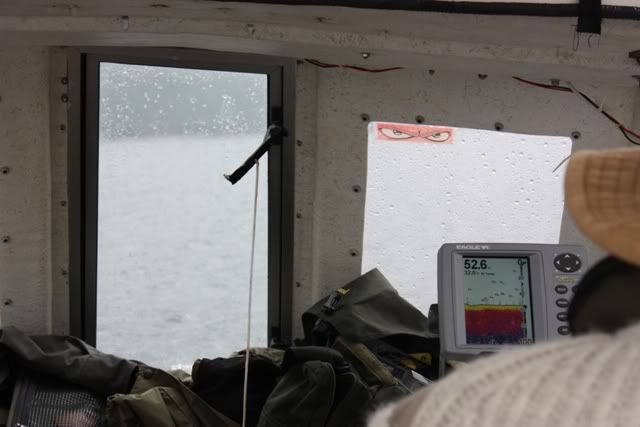
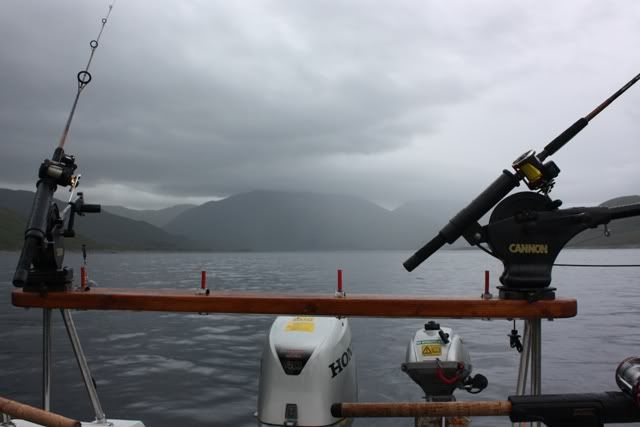
However, let's get the lines out shall we. I'm not keen on down riggers at the start of the day and prefer to get flat lining as quickly as possible. My preferred set up is two side rods port and starboard of at least ten feet ideally twelve and if you can get them, fourteen foot salmon rods with the old style rings. I use floating or shallow running lures on the side rods and then two poker rods of about eight feet with deeper running lures on them. I like to keep things simple and having tried all of the fancy divers and planers prefer to get down deeper if necessary by clipping a small weight to the swivel above the lure. With the down riggers I usually get these working, if I can be bothered one at a time. This means there are always three lines in the water giving optimum opportunity. I've used dead baits but as was proved today they are not essential. Our boat is of the planing hull type giving a good stable fishing platform and it's a sea going boat more than capable of handling nearly anything the Scottish weather can throw at us. We've got a forty horse engine which is very quiet on the troll and a 2.5 h.p. kicker in case the main engine packs in. The boat is fitted with a depth sounder / fish finder which helps in keeping the down rigger canon balls off the bottom and shows but does not catch fish.
FISHING
Well, I've waffled on a bit to get to the main point of the story which is fishing. We headed out into the open loch and were seeing fish pretty quickly on the fish finder. Undoubtedly some of which were Ferox Trout. As far as we're aware there are no Pike in here and if someone was to introduce them it would be shocking.
What were we to expect today ? Weather, fair or foul ? Fish, no fish ? Who knows, it's fishing in Scotland and only the big guy upstairs knows what he's going to give you for your day. Nothing is guaranteed but " God loves a trier " or so they tell me.
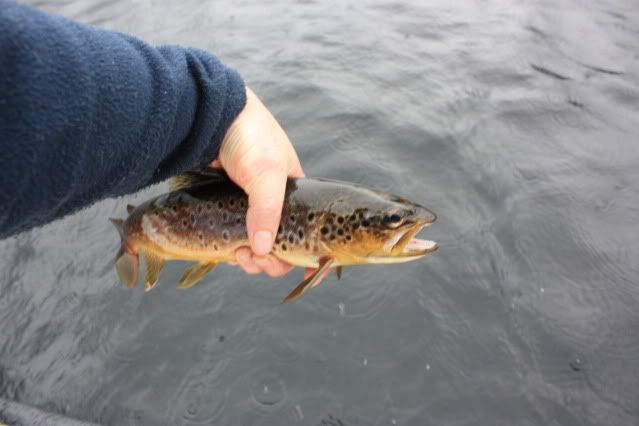
Whirr, my Abu ambassadeur sounded the alarm and it was fish on! We got the other lines in and brought the fish to the boat. Disappointingly it was only a small fish of around three quarters of a pound so we chapped it on the head for the table. We'd brought small Rainbows if we were going to troll dead baits because Broon Troots are too good for bait methinks. Trolling or spinning is o.k. but one of the disadvantages is the fact that the lures and heavier rods can kill the fight and sport you would get if you were fly fishing which is another angle of mine. The fight of a small or not so small Broonie on the light tackle of fly gear is hard to beat and has to be tried to be understood. Fly fishing is a great branch of angling and those who think it's only for toff's should have a go. You can't beat the fight from a strong fish on a light rod.
Anyway here we go again, lines out and troll on. I couldn't believe this, half past ten and the rod is kicking again but this time it's one of the poker rods with a deep running lure on and man it's kicking. Now, this poker rod is a light boat rod but to get it kicking it needs a decent fish. My old man keeps going and I'm telling him to cut the engines and get these other rods in while I'm keeping light pressure on the fish. He's got the other rods in and I can feel the bump, bump ,bump of a big fish sounding against the pressure of the reel. We've got twenty pound line on so I'm not worried about the line breaking but I'm worried about pulling the hook. At this point I'm thinking it's maybe three or four pounds.
The fish is coming in pretty quickly and easy now and I'm thinking maybe it's not so big after all. Then I see it's back and tail and it sees me.

Jeezus, I think, then SPLASH !, it breaks the surface. I'm saying to my dad did you see that and he's like no, I'm like, this is massive, it's a big fish. He's laughing and saying listen to you, you've been watching too much Paul Young and I'm like, this is a big fish it's a really big fish. He's still laughing then the fish breaks the surface again. Geez that's some size he says. Let it run if it wants to, don't pull too hard. I tell him to get the camera and he manages a couple of shots before the fish is ready for the net.
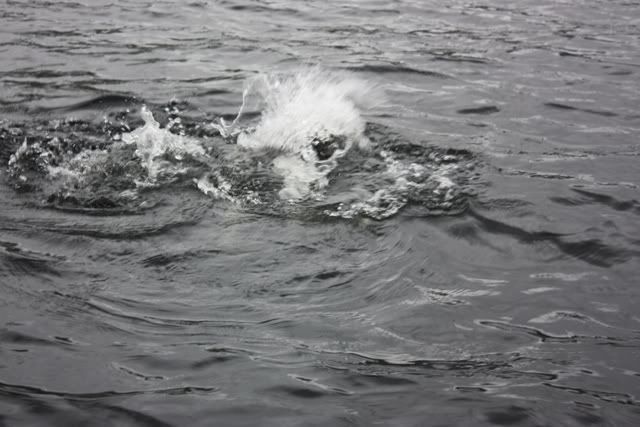
It comes in pretty easily at the end obviously having been determined not to get to the boat. We net it and bring it aboard. Taking the details we need quickly.

All rights reserved
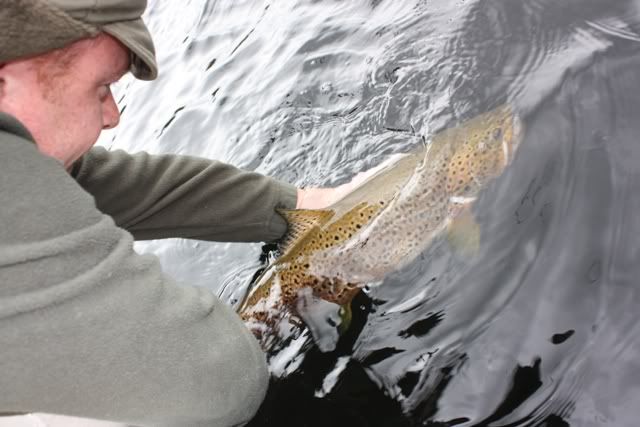
I'm really concerned for the fish and want to get it back in the water a.s.a.p. as we don't have a live well. Unhooking is a quick affair and we manage one shot before the fish is returned to the loch.

All rights reserved
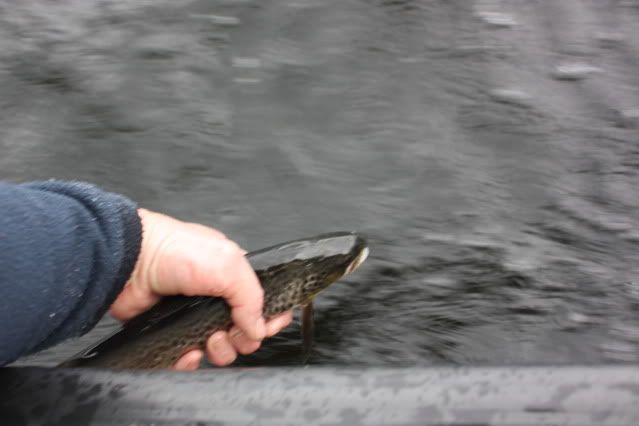
It's obviously used a lot of energy in the fight and takes a good five minutes to recover properly before it gives a good couple of kicks before breaking free and sounding home.
All rights reserved

All rights reserved
Me and the old man shake hands on a job well done and the only thing we have to remind us of this beautiful specimen out of the water is one photograph but it's enough and the feeling of achievement and satisfaction from seeing a belter like that, all 15lbs 10ozs ( length 34" Girth 19" ) of totally wild Scottish Ferox trout, swim away is hard to convey in words.
Well, how do you follow that ? Simple, try for another. We fished all day in fairly reasonable on a kind of trying to rain sort day with another couple of Troot around the pound mark for the pot and a couple returned.
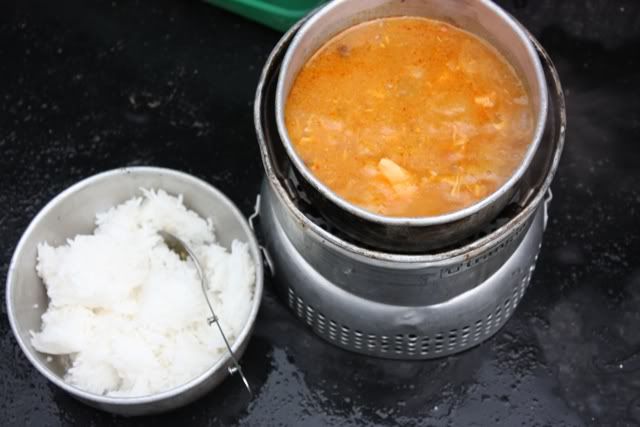
We had lunch on the boat which consisted of chicken curry with rice prepared on my faithfull and battle weary Trangia washed down with a few slugs of Mr. and Mrs. Barr's finest Irn Bru.
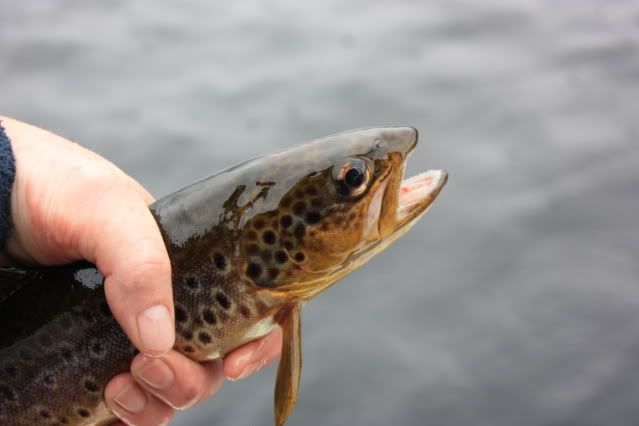
We had one more fish in the afternoon before heading for the lochside and the waiting midgies who had sent out messengers to announce our return in order that their mates could arrive in hoardes to greet us, B*******.
On the way home I had a fish supper at The Bill and we headed down through Bridge of Orchy, Tyndrum, Crianlarich etc., where again at Glen Ogle there was another accident. This time a car had left the road at the bottom and ended up down a steep drop. The cops and ambulance had beat us to it and a mobile crane was in the process of lifting the vehicle back onto the road. I hope the folk that were taken to hospital were o.k.
Now, when's the next time I can get away fishing.
Over 30 years ago, my father caught one of these beauties on another loch in the North West highlands. The fish was around five pounds in weight and at that time we did not know it as a Ferox taking it only to be a large brown trout which must have changed to a fish diet at some point in it's life cycle.

All rights reserved
It was a lovely and well marked fish and regrettably we " chapped it on the head ". In those days this was the norm and the fish was kept for the table. These days, we'll still keep smaller trout but would encourage anyone catching large Ferox to return them. In some way, it's my view, trout which have lived long enough to reach maturity deserve the chance to live another few years and possibly pass their gene's onto the next generation of Ferox. I suppose this makes a case for not taking any trout for the table whatsoever and advocating 100% catch and release. My answer to this would be, 100% Catch and release is a relatively new concept, Ferox have been thriving for thousands of years.
Anyway, what do I know. Back to the trip and the fishing. We travelled up through Fort William to arrive at our camp site for 10 p.m. the light was just beginning to fade and although having been here many years ago we were unable to get a good reminder of how the loch lay before the last fingers of light lifted from the glen and we were plunged into an oily blackness with only the faint glow of what remained of the " Simmer Dim " for a roof.
My father had opted to sleep in the boat and I had brought the tent but really don't like putting one up in the dark so as it was only for one night, decided to sleep in the fourtrack. There was a bit of a breeze but when the wind dropped, the midgies came out and when I say they came out, they came out in force. I organised my gear for the morning as best I could by a small fire of charcoal lit to provide some smoke in order to keep the midgies away.

When camping we normally take charcoal or buy bags of wood rather than going all Ray Mears and hacking down trees. The charcoal doesn't cost much and the logs can be had for around £3.75 at most garages up North. It's a small price to pay for leaving as little trace behind as possible, keeping the landowners happy and ensuring future access. As I sat by the fire that evening, I had a good feeling. I'd been watching the weather and waiting for my window of opportunity. I don't get much of a chance to get out Ferox fishing these days and it was in fact eighteen months since my last trip so I was very hopeful that my research, preparation purchases and planning would bear fruit. However around 1 a.m. as I sat by the fire, the wind changed from a warm westerly to an East wind. Damn, I thought and then pondered that all may not be lost. Maybe if the East wind puts smaller trout which normally feed on insects and flies lower in the water column then the big guys and gals might come out to play. How right I was.
Next morning, after a Lorne sausage or two, cooked over the open fire we broke camp. Replaced the turf where the fire had been set and got the boat hitched up before descending the steep road to the launch site. We were here at this remote highland loch with no fish cages and very little in the way of visitors but the problem was we were not alone. The midgies had decided to turn up for the day too. Hastily, we got the gear in the boat and with me being 1st mate I did the wading as the old man as usual was Captain.
We launched and got as far from shore as quickly as possible. We could have been forgiven for thinking there were trout rising all over this part of the loch as it was completely sheltered from the East Wind and a flat calm prevailed allowing us to see the small bubbles of methane gas which rise from the depths and can look like rising trout from a distance.


We were on our way. For anyone who's not worked it out yet, trolling was to be the order of the day. It's a very effective method of catching Ferox and when you way it out, cost for catch it's probably a bit bonkers by the time you've bought all of your gear and paid for your petrol and launching fees. When you also consider the time which goes into catching memorable fish there's no doubt many of the guys who follow this branch of the sport with a passion could only be described as dedicated. It should be noted that without the Wild fishing forum
http://www.wild-fishing-scotland.co.uk/smf/index.php and the other forum it would have taken so much longer to get to this point in my angling career and I extend my thanks to all who have helped.
However, let's get the lines out shall we. I'm not keen on down riggers at the start of the day and prefer to get flat lining as quickly as possible. My preferred set up is two side rods port and starboard of at least ten feet ideally twelve and if you can get them, fourteen foot salmon rods with the old style rings. I use floating or shallow running lures on the side rods and then two poker rods of about eight feet with deeper running lures on them. I like to keep things simple and having tried all of the fancy divers and planers prefer to get down deeper if necessary by clipping a small weight to the swivel above the lure. With the down riggers I usually get these working, if I can be bothered one at a time. This means there are always three lines in the water giving optimum opportunity. I've used dead baits but as was proved today they are not essential. Our boat is of the planing hull type giving a good stable fishing platform and it's a sea going boat more than capable of handling nearly anything the Scottish weather can throw at us. We've got a forty horse engine which is very quiet on the troll and a 2.5 h.p. kicker in case the main engine packs in. The boat is fitted with a depth sounder / fish finder which helps in keeping the down rigger canon balls off the bottom and shows but does not catch fish.
FISHING
Well, I've waffled on a bit to get to the main point of the story which is fishing. We headed out into the open loch and were seeing fish pretty quickly on the fish finder. Undoubtedly some of which were Ferox Trout. As far as we're aware there are no Pike in here and if someone was to introduce them it would be shocking.
What were we to expect today ? Weather, fair or foul ? Fish, no fish ? Who knows, it's fishing in Scotland and only the big guy upstairs knows what he's going to give you for your day. Nothing is guaranteed but " God loves a trier " or so they tell me.
Whirr, my Abu ambassadeur sounded the alarm and it was fish on! We got the other lines in and brought the fish to the boat. Disappointingly it was only a small fish of around three quarters of a pound so we chapped it on the head for the table. We'd brought small Rainbows if we were going to troll dead baits because Broon Troots are too good for bait methinks. Trolling or spinning is o.k. but one of the disadvantages is the fact that the lures and heavier rods can kill the fight and sport you would get if you were fly fishing which is another angle of mine. The fight of a small or not so small Broonie on the light tackle of fly gear is hard to beat and has to be tried to be understood. Fly fishing is a great branch of angling and those who think it's only for toff's should have a go. You can't beat the fight from a strong fish on a light rod.

Anyway here we go again, lines out and troll on. I couldn't believe this, half past ten and the rod is kicking again but this time it's one of the poker rods with a deep running lure on and man it's kicking. Now, this poker rod is a light boat rod but to get it kicking it needs a decent fish. My old man keeps going and I'm telling him to cut the engines and get these other rods in while I'm keeping light pressure on the fish. He's got the other rods in and I can feel the bump, bump ,bump of a big fish sounding against the pressure of the reel. We've got twenty pound line on so I'm not worried about the line breaking but I'm worried about pulling the hook. At this point I'm thinking it's maybe three or four pounds.
The fish is coming in pretty quickly and easy now and I'm thinking maybe it's not so big after all. Then I see it's back and tail and it sees me.

Jeezus, I think, then SPLASH !, it breaks the surface. I'm saying to my dad did you see that and he's like no, I'm like, this is massive, it's a big fish. He's laughing and saying listen to you, you've been watching too much Paul Young and I'm like, this is a big fish it's a really big fish. He's still laughing then the fish breaks the surface again. Geez that's some size he says. Let it run if it wants to, don't pull too hard. I tell him to get the camera and he manages a couple of shots before the fish is ready for the net.

It comes in pretty easily at the end obviously having been determined not to get to the boat. We net it and bring it aboard. Taking the details we need quickly.

All rights reserved
I'm really concerned for the fish and want to get it back in the water a.s.a.p. as we don't have a live well. Unhooking is a quick affair and we manage one shot before the fish is returned to the loch.

All rights reserved
It's obviously used a lot of energy in the fight and takes a good five minutes to recover properly before it gives a good couple of kicks before breaking free and sounding home.

All rights reserved

All rights reserved
Me and the old man shake hands on a job well done and the only thing we have to remind us of this beautiful specimen out of the water is one photograph but it's enough and the feeling of achievement and satisfaction from seeing a belter like that, all 15lbs 10ozs ( length 34" Girth 19" ) of totally wild Scottish Ferox trout, swim away is hard to convey in words.
Well, how do you follow that ? Simple, try for another. We fished all day in fairly reasonable on a kind of trying to rain sort day with another couple of Troot around the pound mark for the pot and a couple returned.

We had lunch on the boat which consisted of chicken curry with rice prepared on my faithfull and battle weary Trangia washed down with a few slugs of Mr. and Mrs. Barr's finest Irn Bru.


We had one more fish in the afternoon before heading for the lochside and the waiting midgies who had sent out messengers to announce our return in order that their mates could arrive in hoardes to greet us, B*******.
On the way home I had a fish supper at The Bill and we headed down through Bridge of Orchy, Tyndrum, Crianlarich etc., where again at Glen Ogle there was another accident. This time a car had left the road at the bottom and ended up down a steep drop. The cops and ambulance had beat us to it and a mobile crane was in the process of lifting the vehicle back onto the road. I hope the folk that were taken to hospital were o.k.
Now, when's the next time I can get away fishing.
Labels:
Ferox
Subscribe to:
Posts (Atom)
